Why Gender Equality Needs Men: Lessons from Across Africa
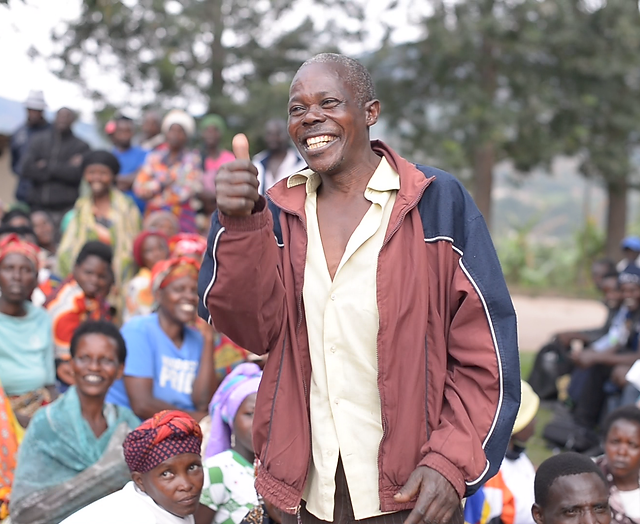
Image © RAMREC
For decades, the global gender equality movement has rightly focused its energy on women and girls. The barriers they face, from violence and discrimination to limited access to education, healthcare, and economic opportunity, are well documented and demand sustained investment and attention. But across Africa, a quiet shift is taking place. Organisations that have spent years working with women and girls are arriving at the same conclusion: lasting change requires bringing men and boys into the conversation too.
This is not about shifting resources or attention away from women. It is about recognising that gender inequality does not exist in a vacuum. It is sustained by social norms, expectations, and models of masculinity that shape how boys grow up understanding power, relationships, and identity. Until those norms are addressed, progress will always have a ceiling. And the organisations doing the hardest work on the ground are learning this not from theory, but from lived experience.
Starting at the Very Beginning
THINKEQUAL, founded by filmmaker turned education activist Leslee Udwin, offers one of the most compelling arguments for intervening early. The organisation grew out of Udwin's documentary India's Daughter, which examined the brutal gang rape of a medical student in Delhi. Through extensive interviews with the perpetrators, Udwin concluded that the root cause of this violence was the socio-cultural programming of inequality, the deeply embedded belief that women and girls are of lesser value.
Her response was not to campaign or protest, but to go upstream entirely. Drawing on neuroscience, which identifies the period before the age of six as the optimal window to shape attitudes, values, and behaviour, THINKEQUAL designed a social and emotional learning programme for children aged three to six. The organisation calls for governments and policymakers to adopt this as a mandatory subject alongside numeracy and literacy arguing that teaching a child mathematics while leaving their values and empathy to chance is a fundamental gap in how we think about education.
The insight is powerful precisely because it is universal. Boys and girls sit in the same classrooms. They absorb the same messages about who matters and who does not. Intervening at this stage means shaping the next generation of men before harmful norms have a chance to calcify.
Rwanda: Tackling Masculinity at the Root
For those boys who grow up without that foundation, the work becomes harder but no less essential. Few organisations embody this more clearly than RWAMREC, the Rwanda Men's Resource Centre, founded in 2006 by Fidèle Ndayisaba. His commitment to this work was deeply personal. Growing up, he witnessed harmful models of masculinity firsthand. Later, working in human rights, he noticed something troubling: violence prevention efforts almost never engaged men directly. Women were supported as survivors. Men were largely absent from the conversation, except as perpetrators. The critical middle ground of engaging men as partners in change was missing entirely.
So Ndayisaba built an organisation to fill that gap. Today, RWAMREC works across all 24 districts of Rwanda, running community-led programmes that engage couples, fathers, young people, and local leaders around caregiving, gender equality, reproductive health, and violence prevention. The results are extraordinary. In one region, their programming contributed to a 60% reduction in emotional intimate partner violence, a 53% reduction in economic violence, a 35% reduction in sexual violence, and a 32% reduction in physical violence. Beyond safety, the work increased men's involvement in childcare and antenatal care, improved mental health outcomes for both men and women, and strengthened communication and shared decision-making within couples.
These are not marginal improvements. They represent transformed relationships, safer homes, and communities where men have actively chosen a different way of living.
Zambia: When Empowering Girls Is Not Enough
Across the continent in Zambia, organisations are reaching similar conclusions through their own hard-won experience. Copper Rose Zambia began its work with a clear and urgent focus on adolescent girls — supporting them with sexual and reproductive health education, menstrual health, and life skills. The need was obvious and the work was essential. But over time, something else became equally obvious: the boys and young men in the same communities were being left behind. Without parallel investment in young men, harmful behaviours were filling the void. The girls Copper Rose was supporting were returning to communities where the norms and behaviours of the men around them had not shifted at all.
This recognition led Copper Rose to expand its programming to include boys and young men — not as a diversion from their mission, but as a deepening of it.
Men of Honour Zambia is tackling the same challenge from a different angle. Working with boys and young men who have often grown up without positive male role models, the organisation focuses on what it means to live with integrity, respect, and responsibility. In communities where dominant models of masculinity are tied to control, toughness, and the suppression of emotion, Men of Honour offers something different: a vision of manhood built on dignity, accountability, and care for others. When boys are given a different story about what it means to be a man one that does not require dominating others to feel secure , the effects ripple outward through families and communities for generations.
The Cost of Not Engaging Men
Perhaps no organisation illustrates the stakes more clearly than Generation Alive, also based in Zambia and founded by Wamba. Generation Alive works to empower and protect women and girls in communities where men hold deeply entrenched social, cultural, and religious authority. From its earliest days, the organisation's unapologetically feminist stance drew fierce resistance — not from the margins, but from the centre of community life.
Wamba received death threats and rape threats. When people discovered she was a mother, the threats extended to her child. Men called into live radio and television programmes demanding that people like her be stoned to death. Prominent religious leaders held press conferences denouncing the organisation's work, framing sexual and reproductive health education as an attempt to encourage children to have sex. The threats were serious enough that Generation Alive avoided putting a sign outside their office for fear of attack.
This was not simply personal hostility. It was a glimpse into what happens when women-led organisations work in communities where men's authority has never been seriously challenged. Even as Generation Alive empowered girls and supported survivors, those girls returned to households and communities where men retained unchallenged control — as fathers, husbands, chiefs, and religious leaders. Empowering girls without engaging the men around them meant constantly working against the grain of the social order rather than with it.
Generation Alive's experience is not unique. It reflects a pattern that gender-focused organisations across Africa encounter repeatedly: that working with women and girls in isolation, however essential, leaves a critical part of the picture unaddressed. The resistance that Wamba and her team faced is itself the argument for why engaging men matters. When male power goes unchallenged, it does not simply stay neutral — it pushes back.
A Pattern Across the Continent
What is striking about these organisations is that they arrived at similar conclusions independently, through direct experience in their own communities. THINKEQUAL saw that discriminatory mindsets form in early childhood and must be addressed there. RWAMREC saw that violence prevention was incomplete without male engagement. Copper Rose saw that girls' empowerment was undermined without parallel work with boys. Men of Honour saw that without alternative models of masculinity, young men would default to harmful ones. And Generation Alive learned, at considerable personal cost, that unchallenged male authority remains the most persistent barrier to the safety and freedom of women and girls.
The specific contexts differ, but the underlying insight is consistent: gender inequality is shaped at every stage of life, and it must be addressed at every stage too.
Both, Not Either
None of this should be mistaken for an argument that investment in women and girls should be reduced. The opposite is true. Women and girls continue to bear the heaviest burden of gender inequality, and the organisations supporting them are doing work that is not only essential but often dangerous. The argument here is additive: that alongside that investment, we also need to invest in the conversations, education, and community structures that help boys and men become active contributors to more equal societies.
Gender equality is not something that can be achieved for women and girls alone. It requires changing the conditions that produce inequality in the first place — and those conditions shape boys and men just as surely as they shape women and girls. The organisations working across Africa understand this. They are not dividing the movement. They are completing it.
